In crypto, “stable” is a relative term. We all remember the Terra Luna crash of 2022 that wiped out $40 billion in days. We remember the panic of 2023 when USDC briefly dropped to $0.87 during the Silicon Valley Bank crisis. The lesson is simple and brutal: Not all digital dollars are created equal.
I’m Mei Lin, Lead Analyst at CoinProfit101. While traders care about which coin pumps the hardest, my job is to ensure your “cash” actually stays cash. If your stablecoin fails, your entire portfolio goes to zero, no matter how good your other trades were.
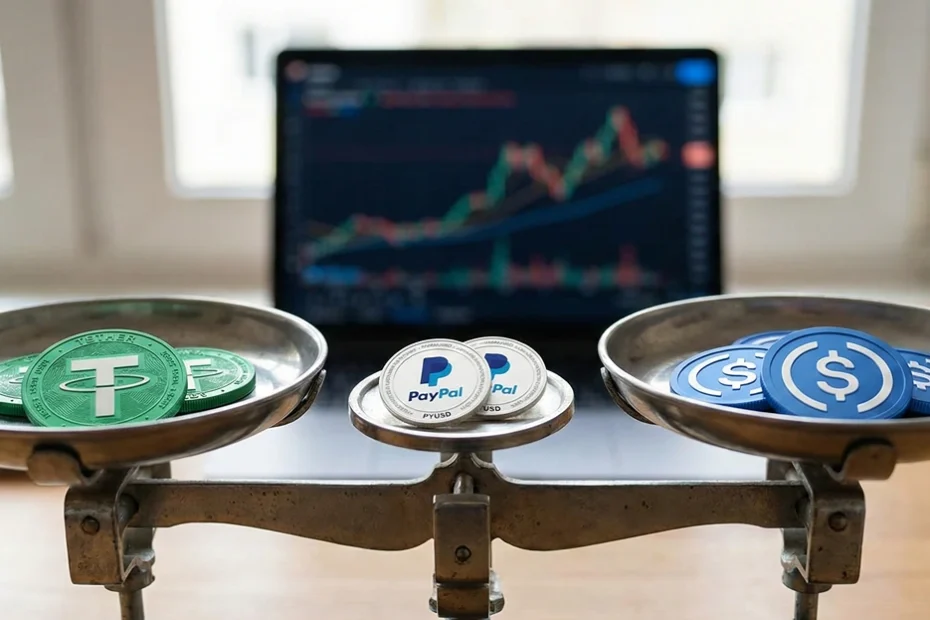
In 2026, the market has consolidated into three giants: the offshore king (USDT), the regulated standard (USDC), and the corporate challenger (PYUSD). Today, we analyze their audit reports, reserve compositions, and legal structures to answer one question: Which is the safest stablecoin for your life savings?
The 2026 Market Snapshot:
As of Q1 2026, these three giants control 92% of the on-chain money supply.
- USDT: $186 Billion Market Cap (Dominates Volume)
- USDC: $75 Billion Market Cap (Dominates DeFi)
- PYUSD: $4 Billion Market Cap (Dominates Retail/Solana)
The Contender 1: Tether (USDT)
The “Too Big to Fail” Giant.
Tether is the oldest and most dominant stablecoin. If you are trading on Binance, Bybit, or any offshore exchange, you are likely using USDT. It is the grease that turns the wheels of the entire crypto economy.
The Reserves (The Good)
Tether has massively improved its balance sheet since the sketchy days of 2017. Today, they hold over $135 Billion in US Treasuries. To put that in perspective, Tether owns more US debt than the countries of Germany or Australia.
Furthermore, Tether is insanely profitable. In 2025 alone, they reported over $10 Billion in net profit. They keep this profit as an “Excess Reserve” buffer. This means that even if some of their assets lose value, they have billions of dollars in cushion to absorb the blow.
The Problem (The Bad)
“Claims” is the operative word. Tether publishes quarterly “Attestations,” not “Audits.”
- Attestation: A snapshot at a specific moment in time. (e.g., “At 11:59 PM on March 31st, we had the money”).
- Audit: A deep, unrestricted review of flows over a period of time.
Tether has historically resisted a full audit by a Big 4 accounting firm. Because they are based in the British Virgin Islands (BVI), they operate in a legal grey area.
The Risk
The risk isn’t that they don’t have the money—they almost certainly do. The risk is Regulatory seizure. If the US Department of Justice (DOJ) ever indicts Tether for facilitating money laundering, they could seize Tether’s Treasury accounts in New York. That would cause an instant, catastrophic de-peg.
The Contender 2: USD Coin (USDC)
The “Wall Street” Favorite.
Issued by Circle, USDC is the backbone of the American crypto ecosystem. If you are buying Tokenized Real Estate (RWA) or using Coinbase, you are using USDC.
The Reserves (100% Transparency)
USDC is backed 100% by cash and short-term US Treasuries. Crucially, these assets are held in a special fund (the Circle Reserve Fund) managed by BlackRock and held at BNY Mellon.
This is the “Gold Standard” of safety. You can literally look up the specific CUSIP numbers of the bonds they hold. There is no guessing. Circle publishes monthly transparency reports that are reviewed by Deloitte.
The “SVB” Lesson
In 2023, USDC de-pegged because $3.3 billion of its cash was stuck in Silicon Valley Bank when it collapsed. Circle learned from this. In 2026, they now hold the majority of their funds in Government Money Market Funds, which are “Bankruptcy Remote.” This means if Circle goes bankrupt, your money is legally separate and safe.
The Contender 3: PayPal USD (PYUSD)
The “Retail” Challenger.
PayPal entered the chat with PYUSD, issued by Paxos. It is integrated directly into Venmo and PayPal, making it the easiest stablecoin for normal people to use.
The Solana Explosion
The biggest story of 2025/2026 was PYUSD’s migration to Solana. By partnering with DeFi protocols like Kamino and Drift, PYUSD offered massive yields to users, driving its market cap from $500M to $4B in a year.
The Regulation (NYDFS)
PYUSD is regulated by the New York Department of Financial Services (NYDFS). This is the strictest crypto regulator on the planet. They require Paxos to hold reserves in strictly segregated accounts. It is safer than a bank account in many ways, although it lacks FDIC insurance.
The Risk: “Walled Garden”
PYUSD has a “Asset Protection” function built into its smart contract. If PayPal or the government decides they don’t like your activity, they can freeze your funds instantly. While USDT and USDC have this too, PayPal is a consumer-facing tech company that is much more likely to freeze funds pre-emptively to avoid bad PR.
Comparison Matrix: The Safety Data
Here is the breakdown of what actually backs these coins.
| Feature | USDT (Tether) | USDC (Circle) | PYUSD (PayPal) |
|---|---|---|---|
| Jurisdiction | Offshore (BVI) | USA (Regulated) | USA (NYDFS) |
| Reserves | Treasuries, Gold, BTC | Cash & Treasuries | Cash & Treasuries |
| Audit Status | Quarterly Attestation | Monthly Transparency | Monthly Attestation |
| Freeze Risk | Low (Selective) | Medium (Compliance) | High (Corporate) |
The Dark Horses: Decentralized Alternatives
If you hate the idea of a company being able to freeze your money, you might look at decentralized stablecoins.
- DAI (MakerDAO): Backed mostly by crypto assets (and some RWA). It is censorship-resistant but carries smart contract risk.
- USDe (Ethena): The “Synthetic Dollar.” It uses a delta-neutral hedging strategy to maintain the peg. It offers high yield but carries complex derivative risks.
The “De-Peg” Risk Analysis
No stablecoin is risk-free. Here is what could go wrong with each.
Why They Are Safer in 2026
- Interest Rates: High rates mean these companies make billions in profit just by holding your money. They are highly incentivized to keep the system running.
- Separation: Unlike FTX, where user funds were mixed with corporate funds, USDC and PYUSD hold reserves in “Bankruptcy Remote” accounts.
The Hidden Dangers
- USDT: If the US Government bans Americans from transacting with Tether entities, liquidity could dry up overnight.
- USDC/PYUSD: If you are a citizen of a sanctioned country (like Russia or Iran), these coins can be frozen in your wallet without warning.
Mei’s Final Verdict: Which One Should You Hold?
I don’t keep all my eggs in one basket, and neither should you. Here is my allocation strategy for 2026:
1. For Trading (40%): Use USDT.
It has the most trading pairs and the deepest liquidity. If you want to buy altcoins quickly on a CEX, Tether is still king. It is too big to ignore.
2. For Savings / DeFi (50%): Use USDC.
If I am staking for yield or holding cash on my Ledger, I use USDC. I sleep better knowing BlackRock is holding the collateral and that I can redeem it 1:1 for USD via Coinbase at any time.
3. For Payments (10%): Use PYUSD.
If I need to send money to a friend for dinner, PYUSD on Solana is unbeatable. It is fast, cheap, and easy to off-ramp directly to a bank account.
FAQs

Mei Lin is a Senior Market Data Analyst at CoinProfit101.com, where she tracks institutional capital flows and macroeconomic trends affecting the digital asset market. With an eye for on-chain data and the “Digital Gold” thesis, Mei breaks down how global events and ETF developments impact long-term Bitcoin adoption. Her work focuses on providing objective, data-driven insights that help investors look past short-term noise to understand the broader market cycle. Mei is passionate about financial literacy and making high-level market analysis accessible to the 101-level investor.