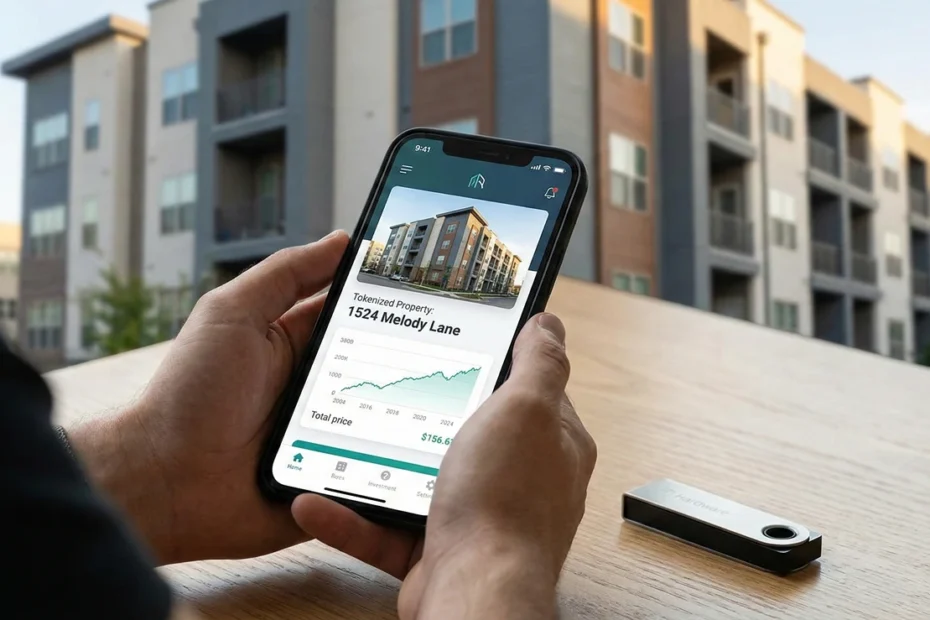
In 2026, you don’t need a mortgage, a credit check, or a realtor to become a landlord. You need $50 and a digital wallet.
For years, crypto was mocked as “fake internet money” with no backing. But the arrival of Real World Assets (RWA) has silenced the critics. BlackRock, Citibank, and massive private equity firms are now moving trillions of dollars of physical assets onto the blockchain. They aren’t doing it for the “tech”—they are doing it because it is cheaper, faster, and more liquid than the traditional banking system.
I’m Mei Lin, Lead Analyst at CoinProfit101. While the internet is buzzing with hype, my job is to look at the numbers and the legal contracts. Today, I will explain how to buy tokenized real estate safely, which platforms actually pay rent, and why this might be the best (or worst) decision for your portfolio.
The 2026 RWA Boom:
The total value of “Tokenized Real Estate” surpassed $12 Billion in Q1 2026. Properties in Detroit, Miami, and Liverpool are now being traded 24/7 on-chain, paying out daily yields in USDC directly to investors’ wallets.
What is RWA? (The “Digital Brick” Concept)
RWA stands for Real World Assets. It is the process of taking a physical asset (like a $1 million apartment building) and splitting it into 20,000 digital tokens.
When you buy tokenized real estate, you are technically buying a “fractional share” of the property. But how does a digital token prove you own a physical house?
The “SPV” Legal Structure
This is the boring legal part that matters most. You don’t just “own a token.” The process works like this:
- The Company: A platform creates a unique LLC or SPV (Special Purpose Vehicle) for each specific house.
- The Deed: That LLC buys the house. The deed is in the name of the LLC.
- The Token: The platform issues tokens that represent shares of that LLC.
So, when you hold the token, you legally own a share of the company that owns the house. If the tenant pays $2,000 rent, and you own 1% of the tokens, the smart contract automatically sends $20 (in USDC) to your wallet.
Top 3 Platforms to Buy Tokenized Real Estate in 2026
Not all platforms are created equal. I have analyzed the on-chain data, payout history, and legal structures for the top contenders.
1. RealT (The Veteran)
Blockchain: Gnosis Chain & Ethereum
Best For: Consistent Income & Section 8 Housing.
RealT is the “Gold Standard” for stability. They focus heavily on subsidized housing in the US Rust Belt (Detroit, Cleveland, Toledo). These properties aren’t glamorous, but the rent is guaranteed by the government.
- Yield: Consistent 9% – 11% APY.
- Payout: Rent is paid daily in USDC.
- Liquidity: They have a DeFi liquidity pool (LevinSwap) where you can sell your tokens instantly if you need cash.
2. Lofty (The DAO)
Blockchain: Algorand
Best For: Governance & Control.
Lofty runs on the Algorand blockchain (which is fast and cheap). The unique twist is that token holders act as a “DAO” (Decentralized Autonomous Organization). You don’t just collect rent; you manage the property.
- Voting: Token holders vote on whether to raise the rent, evict a tenant, or pay for a new roof.
- The Marketplace: Lofty has a vibrant secondary market where you can snipe underpriced properties from other users.
3. Parcl (The Trader)
Blockchain: Solana
Best For: Speculation & Hedging.
Parcl is different. You aren’t buying a specific house; you are betting on the “City Index.” It uses complex data feeds to track the price per square foot in cities like Miami, New York, or London.
- The Strategy: Think housing prices in Miami will crash? You can “Short Miami” on Parcl with 5x leverage.
- No Rent: You don’t get rental income. You only profit if the price of the city’s real estate moves in your direction.
Tutorial: How to Buy Your First “Digital Brick”
Buying RWA is not like swapping meme coins on Uniswap. Because these are real assets, you have to follow real laws.
Step 1: The KYC (Know Your Customer)
You cannot be anonymous. You must upload your ID (Passport or Driver’s License) to the platform. This links your identity to your wallet address.
Time to complete: ~10 minutes.
Step 2: Prepare Your Wallet
You need a self-custody wallet.
- For RealT: Use MetaMask or a Ledger Nano X. You will need xDAI (for gas) and USDC (to buy).
- For Parcl: Use Phantom Wallet. You will need SOL (for gas) and USDC.
Step 3: The Purchase
Browse the marketplace. When you see a property you like (e.g., “1524 Melody Lane”), click Buy. You will sign a transaction approving the USDC spend.
Note: For RealT, you will also sign a digital legal document (Deed of Adherence) confirming you are a shareholder.
Step 4: Receive Rent
There is no “Claim” button. The rent just shows up. Every evening, you will see a small deposit of USDC land in your wallet. It is arguably the most satisfying notification in crypto.
RWA vs. REITs: The Data Breakdown
Traditional investors often ask: “Why not just buy a REIT (Real Estate Investment Trust) on the stock market? It’s safer!”
They have a point. But RWA offers advantages that Vanguard cannot match.
| Feature | Tokenized Real Estate (RWA) | Traditional REIT (Stock) |
|---|---|---|
| Payout Frequency | Daily / Weekly | Quarterly (Every 3 Months) |
| Trading Hours | 24/7 (Always Open) | 9:30 AM – 4:00 PM (M-F) |
| Minimum Investment | $50 | $100 – $500 |
| Fees | ~1% – 3% (Platform Fees) | ~0.03% (Expense Ratio) |
| Tax Complexity | High (See Alex’s Tax Guide) | Low (Standard 1099-DIV) |
Pros & Cons of Tokenized Real Estate
Is this strategy right for you? Let’s weigh the benefits against the downsides.
The Upside
- Liquidity: Need cash? You can sell your “house” tokens instantly on a DEX like Uniswap. No waiting 6 months for a realtor.
- Diversification: You can own 1% of a house in Miami, Chicago, and Austin for under $200.
- Accessibility: No credit checks. No mortgage rates. Just connect your wallet.
The Downside
- Platform Risk: If the platform goes bankrupt, recovering your legal deed is a nightmare.
- Vacancy Risk: If the tenant leaves, the rent stops. You don’t have the “safety net” of a massive REIT portfolio.
- Gas Fees: On Ethereum, gas fees can eat your profits. Always use L2s or sidechains (like Gnosis or Algorand).
Security Warning:
Where do you store these tokens? Do NOT leave them on the website. Withdraw them to your own wallet. However, be careful—if you lose your private key, you cannot just “reset password.” Read Julian’s review of Ledger vs Trezor to see which wallet supports these assets best.
Mei’s Final Verdict
RWAs are the future of finance, but we are still in the “Early Adopter” phase. The technology works, the yields are real, and the daily payout is addictive.
My strategy? I treat RWAs as my “High Yield Savings Account.” I put 5% of my portfolio here to enjoy the passive income, but I never invest money I might need tomorrow. Liquidity is good, but it is not guaranteed.
FAQs (Frequently Asked Questions)
You have two options:
- Sell back to the Platform: Some platforms offer a buy-back program during specific windows.
- Secondary Market: You can sell on a DEX (like Uniswap for RealT or the Lofty Marketplace). This is faster, but the price might be slightly lower than the official appraisal value.

Mei Lin is a Senior Market Data Analyst at CoinProfit101.com, where she tracks institutional capital flows and macroeconomic trends affecting the digital asset market. With an eye for on-chain data and the “Digital Gold” thesis, Mei breaks down how global events and ETF developments impact long-term Bitcoin adoption. Her work focuses on providing objective, data-driven insights that help investors look past short-term noise to understand the broader market cycle. Mei is passionate about financial literacy and making high-level market analysis accessible to the 101-level investor.