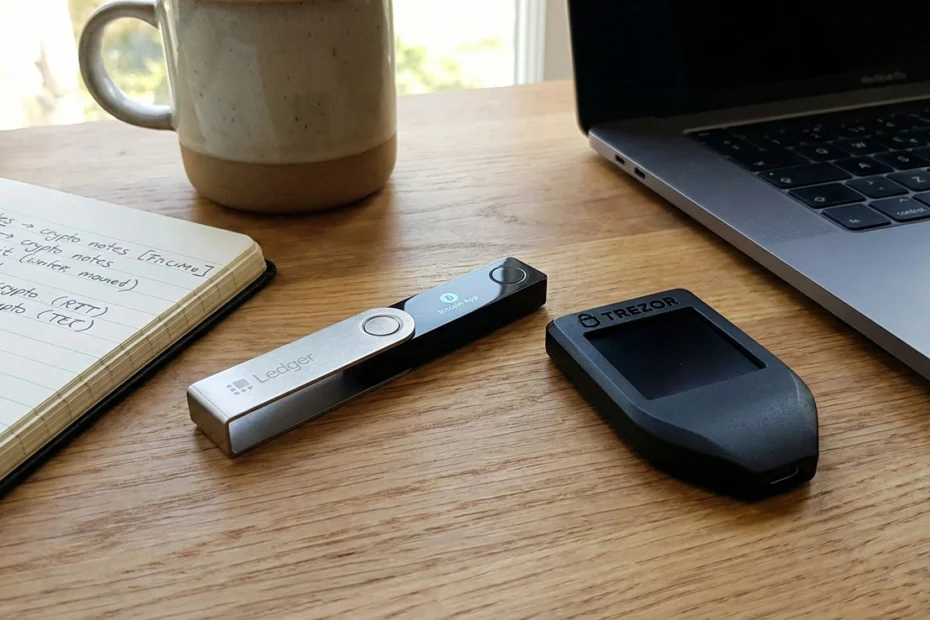
In the battle of Ledger Nano X vs Trezor Safe 3, your choice comes down to one question: Do you value convenience or privacy?
I’m Julian Vance, the “Paranoid Security” lead here at CoinProfit101. I have been using hardware wallets since the days we had to solder them ourselves. Today, the market is dominated by two French and Czech giants. But after the “Ledger Recover” controversy of recent years, the landscape has shifted.
In 2026, is the classic Ledger still the king? Or has the new Trezor Safe 3 stolen the crown? Let’s tear them apart.
Quick Verdict:
- Best for iPhone Users: Ledger Nano X (Bluetooth is king).
- Best for Paranoia: Trezor Safe 3 (Open Source + Secure Element).
The Contender: Ledger Nano X
The “Apple” of Crypto.
The Ledger Nano X is beautiful. It feels heavy, expensive, and polished. It connects to your iPhone via Bluetooth, allowing you to move funds while sitting at a coffee shop.
The Security Model (Secure Element): Ledger uses a proprietary chip called a “Secure Element” (rated EAL5+). This is the same chip used in credit cards and passports. It is extremely difficult to hack physically.
The Problem (Closed Source): However, because that chip is proprietary, the firmware running on it is “Closed Source.” You cannot see the code. You have to trust Ledger that there are no backdoors. After they launched “Ledger Recover” (a service to backup your seed phrase online), that trust was shaken for many users like me.
The Challenger: Trezor Safe 3
The “Linux” of Crypto.
The Trezor Safe 3 was Trezor’s answer to the critics. For years, Trezor devices had one weakness: if a hacker physically stole the device, they could extract the keys using a voltage glitch attack.
The Safe 3 fixed this. It introduced a generic Secure Element (EAL6+) to protect against physical attacks, but—crucially—kept the firmware Open Source.
In the debate of Ledger Nano X vs Trezor Safe 3, this is the killer feature. You can audit the code yourself. There is no “trust me, bro.”
Ledger Nano X
- Bluetooth: Works wirelessly with iOS & Android.
- App: Ledger Live is the best UI in the industry.
- Support: Massive coin support (5,500+).
- Downside: Closed Source Firmware.
Trezor Safe 3
- Security: Open Source + EAL6+ Chip.
- Privacy: No battery, no Bluetooth (Air-gapped feel).
- Price: Usually cheaper ($79 vs $149).
- Downside: Must plug into a computer/phone via cable.
Julian’s Final Verdict: Which One?
If you trade active DeFi positions or need to move funds while traveling, get the Ledger Nano X. The Bluetooth convenience is undeniable, and despite the FUD (Fear, Uncertainty, Doubt), no Ledger device has ever been remotely hacked.
But, if you are storing your life savings—funds you plan to leave to your children—get the Trezor Safe 3. The combination of Open Source code and the new Secure Element makes it the “Gold Standard” for cold storage in 2026. It removes the need to trust a corporation.
Remember, whichever you choose, never type your seed phrase into a computer. (Read my guide on Securing Your Recovery Phrase if you are unsure why).
FAQs

Julian Vance is a blockchain security researcher with a focus on cold storage protocols and decentralized network integrity. At CoinProfit101.com, Julian specializes in translating complex technical security concepts into plain English for everyday investors. Driven by the philosophy of “Don’t Trust, Verify,” he provides in-depth research into wallet vulnerabilities, phishing prevention, and the evolving landscape of digital asset custody. Julian’s goal is to ensure that every reader has the knowledge to be their own bank safely in the 2026 crypto environment.