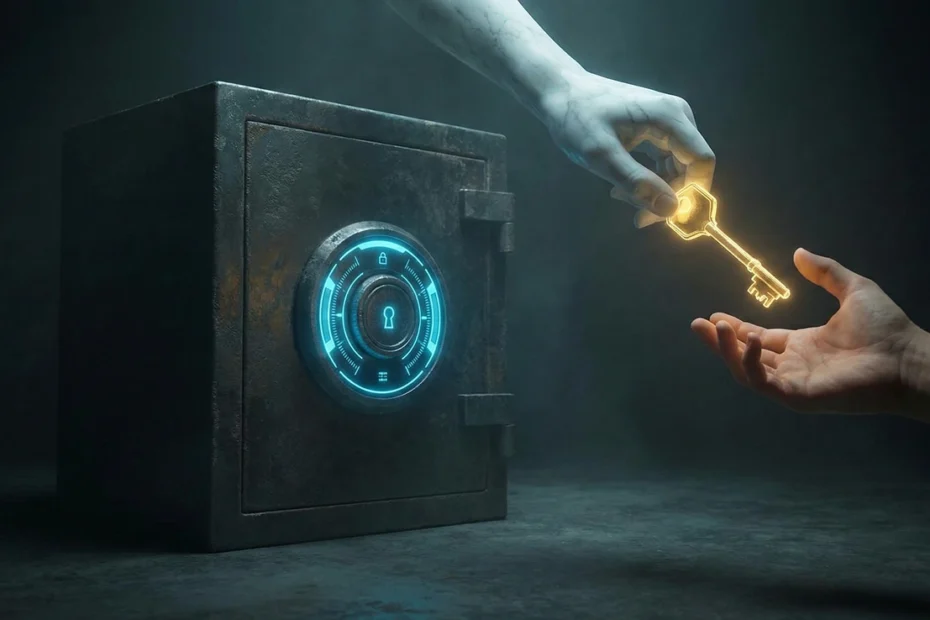
You have spent years stacking sats, optimizing your portfolio, and securing your keys. But you have a massive blind spot.
If you were hit by a bus tomorrow, would your family be able to access your wealth? Or would your crypto inheritance plan die with you?
It is a dark question, but a necessary one. I’m Alex Sterling, and I’ve seen too many families left with millions of dollars in “phantom wealth”—Bitcoin they can see on the blockchain but cannot touch because the owner didn’t leave instructions.
In 2026, you don’t need an expensive estate lawyer to fix this. You need a “Dead Man’s Switch.”
Stats:
A recent study by the Crypto Asset Institute estimates that over 4 million BTC (worth billions) are lost forever due to death or lost keys. Don’t let your life’s work become a donation to the network.
Why A Standard Will Doesn’t Work for Crypto
Most people think, “I’ll just put it in my will.” This is a fatal mistake for your crypto inheritance plan.
If you write your 24-word recovery phrase in a legal will, that document becomes a public record when you die. Anyone—probate clerks, nosy relatives, or hackers scanning court records—can read it and drain your wallet before your family even gets to the funeral.
You need a system that is private, secure, and trustless.
The 3-Tier “Dead Man’s Switch” Strategy
I advise my high-net-worth clients to use a tiered system. This ensures that no single person (not even your spouse) has full access while you are alive, but they get full access if you are gone.
Level 1: The “Low-Tech” Letter (For Beginners)
This is the simplest version of a crypto inheritance plan.
- Step 1: Write down the location of your hardware wallet (e.g., “The safe in the master bedroom”).
- Step 2: Write down the PIN code to that device.
- Step 3: Seal this in an envelope marked “For My Spouse Only.”
- Step 4: Ensure your spouse knows where your Recovery Phrase is hidden (separate from the device).
Helpful Hint:
The “Shamir” Trick: If you don’t trust anyone with the full seed phrase, cut your 24-word list in half. Give words 1-12 to your brother and words 13-24 to your spouse. They can only access the funds if they work together.
This is Part 2 of the article. It covers the advanced “Dead Man’s Switch” methods, the Pros/Cons section, and the FAQ.
Copy and paste this directly below Part 1 in your WordPress editor.
📝 Article Part 2: The Automated Solutions & FAQs
Level 2: The “Dead Man’s Switch” (Software Solutions)
If you don’t trust physical paper (which can burn or be stolen), you can automate your crypto inheritance plan using software. This is often called a “Dead Man’s Switch.”
The concept is simple: The software sends you an email every 30 days asking, “Are you alive?” If you click the link, nothing happens. If you fail to click the link for 90 days (and don’t respond to reminders), the software automatically releases an encrypted file to your designated heirs.
Tools I Recommend in 2026:
- Sarcophagus: A decentralized “switch” built on Ethereum and Arweave. If you don’t “attest” (check-in) on-chain, it reveals your payload to the recipient address.
- Safe (formerly Gnosis Safe): For families with large portfolios ($100k+), setting up a Multisig Wallet is the gold standard. You can require 2-of-3 signatures to move funds: one key for you, one for your spouse, and one for a lawyer. If you pass away, the lawyer and spouse can combine their keys to access the funds.
Level 3: The “Smart Contract” Will (Advanced)
For the truly paranoid or tech-savvy, you can program your will directly into the blockchain. This removes human error entirely from your crypto inheritance plan.
In this setup, you lock your Bitcoin or Stablecoins into a smart contract vault. You program a “heartbeat” transaction that you must send once a year. If the contract doesn’t receive your heartbeat for 365 days, it automatically executes a transfer to the wallet addresses of your children or beneficiaries.
Helpful Hint:
Warning: Be careful with full automation. If you are in a coma for 13 months and recover, you might wake up to find your automated contract gave all your money away. Always include a long “grace period” (e.g., 6-12 months) before the funds transfer.
Inheritance Method Comparison
Pros of “Dead Man’s Switch”
- Privacy: Unlike a legal will, no government clerk or nosey relative can read your asset list.
- Automation: Your heirs get the funds automatically without waiting months for probate court.
- Censorship Resistance: No judge can freeze the transfer. It is code, not law.
Cons of “Dead Man’s Switch”
- Technical Risk: If the smart contract has a bug, the funds could be lost forever.
- Coma Risk: If you are incapacitated but alive, you might accidentally trigger the transfer too early.
- Complexity: Your heirs need to know how to use a crypto wallet to receive the funds.
What About Taxes? (Crucial Warning)
Just because you bypass the probate court doesn’t mean you bypass the IRS. In 2026, the “Step-Up in Basis” rule still applies to crypto, which is actually good for your heirs.
If you bought Bitcoin at $10,000 and die when it is $150,000, your heirs inherit it at the $150,000 cost basis. They don’t pay capital gains tax on the profit you made while alive. However, if they sell it later at $160,000, they only pay tax on the $10,000 gain.
(Note: I am a strategist, not a CPA. Always consult a tax professional).
If you are worried about the costs of holding these assets long-term, check out our guide on Bitcoin ETFs vs. On-Chain Fees to see if moving your “inheritance stack” to an ETF might be cheaper for your family to manage.
FAQs

Alexander is a cryptocurrency researcher and the creator of CoinProfit101.com. Driven by a passion for decentralized finance and macroeconomics, He focuses on the intersection of institutional adoption and Bitcoin’s “Digital Gold” thesis. His goal is to provide a “101-level” entry point for complex financial topics, ensuring that new investors have the data-driven tools needed to succeed in the 2026 market. Alex holds a deep interest in cold storage security and long-term wealth preservation strategies.